
All Ages Dental Spa treats snoring and obstructive sleep apnea (OSA) in Tampa, FL, with custom-made oral appliances and laser snoring therapy. Our office at 11333 Countryway Blvd works alongside your physician and sleep specialist, so you get a medical diagnosis, a comfortable device fitted by a dentist, and follow-up to confirm it is working. Many of our patients come to us because they could not tolerate a CPAP machine or want an option they can travel with.
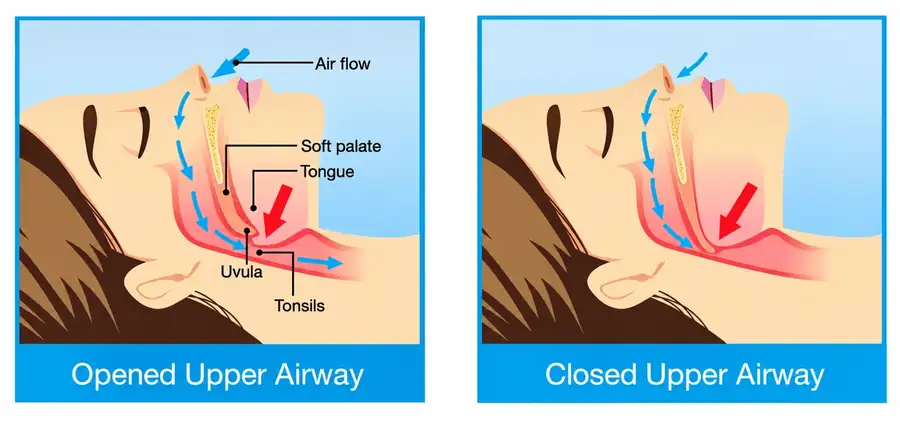
Obstructive sleep apnea is a breathing disorder that happens during sleep. When you lie down and your muscles relax, the tongue and the soft tissues at the back of the throat (soft palate, uvula and tonsils) can fall back and narrow the airway. A partial blockage makes the tissues vibrate, which is the sound of snoring. A complete blockage stops airflow for several seconds at a time, and the brain briefly wakes you up to start breathing again. This can repeat dozens of times per hour without you remembering it.

Sleep apnea is common and often goes unnoticed. The American Academy of Sleep Medicine (AASM) estimates that about 30 million adults in the United States have obstructive sleep apnea and that roughly 23.5 million of them are undiagnosed. The AASM also reports that 30% to 40% of adults with high blood pressure have sleep apnea.
As dentists, we often see clues during a routine exam: worn or cracked teeth from nighttime grinding, a scalloped tongue, a narrow arch or enlarged tonsils. If we notice these signs, we will talk with you about a sleep screening.
Each pause in breathing lowers the oxygen in your blood and puts stress on the heart. Untreated obstructive sleep apnea is associated with high blood pressure, heart disease, stroke, type 2 diabetes and drowsy-driving accidents. It also affects the people around you: loud snoring is one of the most common reasons couples end up sleeping in separate rooms. Treatment usually improves energy, mood and focus within the first weeks.
An oral appliance, also called a mandibular advancement device, is a custom-fitted mouthpiece worn only while you sleep. It gently holds the lower jaw slightly forward, which keeps the tongue and soft tissues from collapsing into the back of the throat. The airway stays open, airflow becomes steady and snoring is reduced or eliminated.

The American Academy of Sleep Medicine and the American Academy of Dental Sleep Medicine published a joint clinical practice guideline recommending oral appliance therapy for adults with primary snoring, and for adults with obstructive sleep apnea who cannot tolerate CPAP or prefer another option. The guideline favors a custom, titratable appliance made by a qualified dentist over over-the-counter devices, with follow-up to check the bite and a follow-up sleep test to confirm results. That is the approach we follow.
For patients whose snoring comes mainly from loose tissue at the back of the mouth, we also offer laser snore treatment. The laser gently tightens the soft palate and surrounding tissue so it is less likely to vibrate or collapse during sleep. It is done in the office, with no cuts or stitches, and it can be combined with an oral appliance. Learn more on our laser dentistry page.
Oral appliance therapy is a good fit for adults with primary snoring, for mild to moderate obstructive sleep apnea, and for people with OSA who have tried CPAP and could not keep using it. Patients with severe sleep apnea may still need CPAP, sometimes combined with an appliance. You need enough healthy teeth to hold the appliance in place. During your consultation we will tell you honestly which option fits your case.
Yes. A physician diagnoses obstructive sleep apnea with a sleep study, and a trained dentist can provide oral appliance therapy as treatment. At All Ages Dental Spa we work with your physician from diagnosis to follow-up.
For many adults with mild to moderate sleep apnea, and for those who cannot tolerate CPAP, a custom oral appliance is an effective alternative recommended by the American Academy of Sleep Medicine. In more severe cases it can be used together with CPAP.
Most patients notice a large reduction in snoring once the appliance is adjusted. Because snoring can be a sign of sleep apnea, we recommend a sleep screening before treating snoring alone.
It is custom-made from records of your teeth, so it fits closely and is adjusted gradually. Some patients feel mild jaw or tooth tenderness in the first mornings, which usually fades within a few weeks.
Oral appliance therapy for diagnosed sleep apnea is often billed to medical insurance, not dental insurance. Coverage depends on your plan. Our team can help you check your benefits, and patients without insurance can save with our membership plans.
Children can also have sleep apnea, often linked to enlarged tonsils or adenoids. If we see signs in a child, we refer the family to a pediatrician or pediatric sleep specialist for evaluation.
All Ages Dental Spa is led by Dr. Maria Totzke and serves patients from Tampa, Westchase, Town ‘n’ Country, Citrus Park, Oldsmar and the surrounding Hillsborough County area. Our team speaks English, Portuguese and Spanish. If you or your partner snore, or you wake up tired every day, call 813.814.4000 or book a sleep apnea consultation.
Sources: American Academy of Sleep Medicine, “Millions of Americans have undiagnosed obstructive sleep apnea” (2021 Sleep Prioritization Survey); Ramar K. et al., “Clinical Practice Guideline for the Treatment of Obstructive Sleep Apnea and Snoring with Oral Appliance Therapy: An Update for 2015,” Journal of Clinical Sleep Medicine, AASM/AADSM. This page is for educational purposes and does not replace a medical diagnosis.
